

In Licking County, 37% of our neighbors are one flat tire or one healthcare bill away from financial disaster, according to a report from the United Way of Licking County.
The Licking County Foundation wants to do something about it.
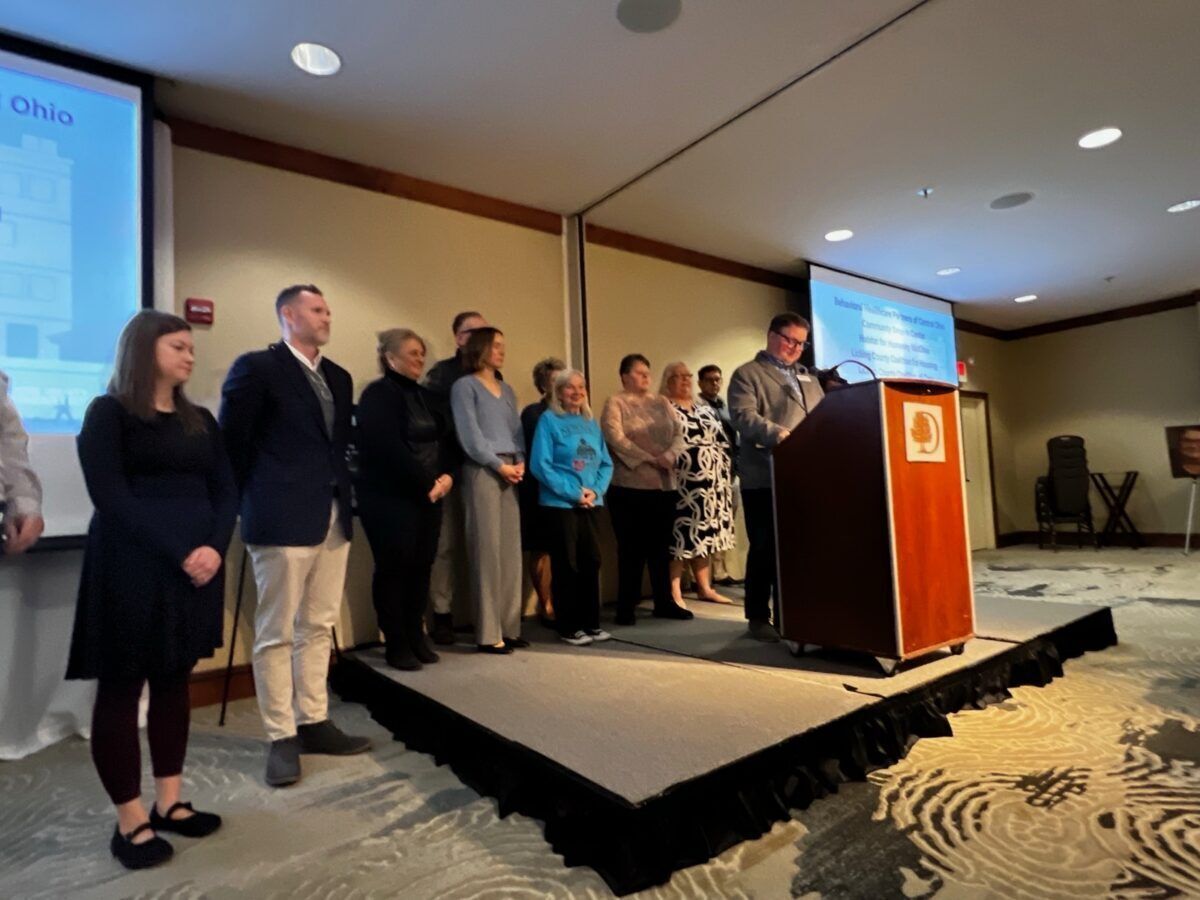
“For many of our neighbors the reality of homelessness, or the safety and security of maybe losing their home, is not abstract, it’s real and it’s immediate,” Licking County Foundation President Mike Schmidt said on Friday morning to a packed room at the DoubleTree in downtown Newark.
“When one neighbor struggles, it affects all of us,” Schmidt said.
This was the throughline Friday morning at a breakfast event hosted by the Licking County Foundation (LCF) at which the foundation launched an effort to educate and address homelessness and the housing crisis.
The foundation’s two-pronged approach will include an extensive education campaign as well as hiring five community navigators, advocates who help connect people to services, support and housing.
Bobby Persinger, program officer at LCF, explained that the education campaign, dubbed “Licking County is My Home,” will bring awareness about the realities of housing instability and played a short video featuring community members struggling with housing as well as those who can support them.
The purpose of the education campaign, Persinger said, is “to move this issue from abstract to personal, from statistics to real-life stories.”
Persinger said the goal is a system that does not just “respond to crisis, but prevents it.”
To that end, the second prong, to hire five community navigators, was inspired by the successful work of the Licking County Health Department’s first community navigator, Sherry Selfe. This position is supported by opioid settlement dollars – money distributed to state, county and local governments following legal settlements with various opioid manufacturers, distributors and pharmacies – and has become critical to the work of the Licking County HOME Court.
Navigators support people experiencing homelessness or housing instability by facilitating their efforts to seek more stable housing.
These new navigators will be based at organizations collaborating with LCF. They will all work together, “kind of like The Avengers,” Persinger said, to cover the entire county together and avoid duplication of services.
LCF’s announcement comes after an 18-month long collaborative discernment process called “At the Table,” which brings together community leaders to develop solutions that are both achievable and sustainable.
Organizations involved include the Community Drop-In Center, the Salvation Army, St. Vincent Haven, the Main Place, Newark Homeless Outreach, Habitat for Humanity, Behavioral Health Partners of Licking County, the Licking County Coalition of Care and Licking County Coalition for Housing.
Persinger said that while the new two-pronged approach that LCF will take emerged from these meetings, the issues are not new to the community.
“So many have been doing this work for a while–nonprofits, government, business, faith community and philanthropy,” he said.
He noted recent efforts by Legal Aid, United Way, and HOME Court.
LCF has invested over $2 million to local organizations addressing homelessness and housing since 2016. LCF has also been a major supporter of affordable housing in Licking County.
Read more: Licking County Foundation announces partnership to boost affordable housing in Licking County
LCF has invested $75,000 to support the education and awareness campaign and $475,000 to support the five navigators. The total costs for those positions will be closer to $1,900,000. The foundation’s goal is to raise the funding to make up the balance.
The need is great, according to Trina Woods, executive director of the Licking County Coalition for Housing. Woods told the audience that the organization is currently helping to house 195 households representing 328 people in addition to the 110 unsheltered households and 65 in emergency shelters seeking permanent housing.
“These are people who went to school here in Licking County. These are people that served honorably in our military. These are people serving you coffee, serving you lunch, sitting beside you,” Woods said. “These are your neighbors”
All of these people, she said, have different stories.